Programme overview
A research programme, not a predetermined conclusion
The AIR Research Programme brings together a versioned public-source case database, a country-year social-context database and an explicit conceptual framework. Its purpose is to make patterns inspectable, methods contestable and uncertainty visible.
AIR asks whether documented online curation, immersion and reinforcement can help explain some pathways to coercive or violent mobilisation. It does not assume that social media exposure causes violence, that any identity group is inherently risky, or that national trends explain why a particular person acted.
Contextual co-movement, chronological overlap and case-level online evidence are different forms of evidence. No single form of evidence, alone, establishes an algorithmic causal effect.
Research agenda
Questions the infrastructure is designed to test
Change over time
How have recorded terroristic attacks, thwarted plots and CIVM incidents changed by place, category and documented AIR evidence?
Pathways and outcomes
Which documented online behaviours, spaces and mobilisation patterns recur across otherwise different cases?
Social context
How have measured digital, institutional, demographic, health, economic and public-safety conditions changed within each country?
Alternative explanations
Which observed patterns may reflect law, disclosure, media attention, reporting practices, case selection or other non-causal data processes?
Conceptual model
The proposed AIR cycle
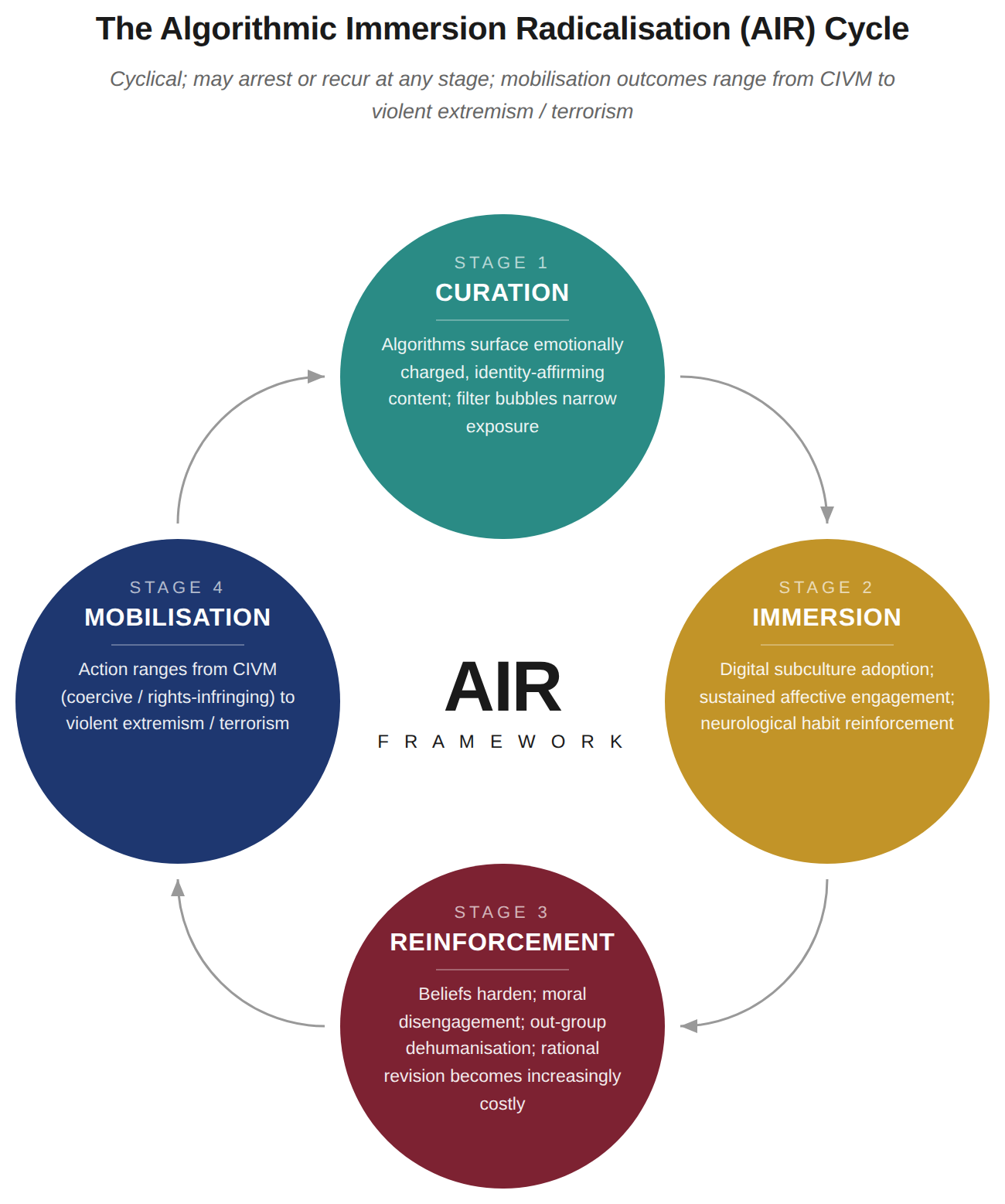
The AIR cycle organises a possible pathway into four stages: curation, immersion, reinforcement and mobilisation. It is a framework for generating testable propositions, not a claim that exposure necessarily progresses to harm.
Read the figure description
The model begins with a proposed curation stage, followed by immersion, reinforcement and mobilisation. These are theory-led domains for investigation rather than observed states or a universal sequence. Arrows show the original cyclical hypothesis; they do not establish progression, direction, neurological change or a causal algorithmic effect.
Operational boundary
Lawful engagement, CIVM and terrorism are not interchangeable
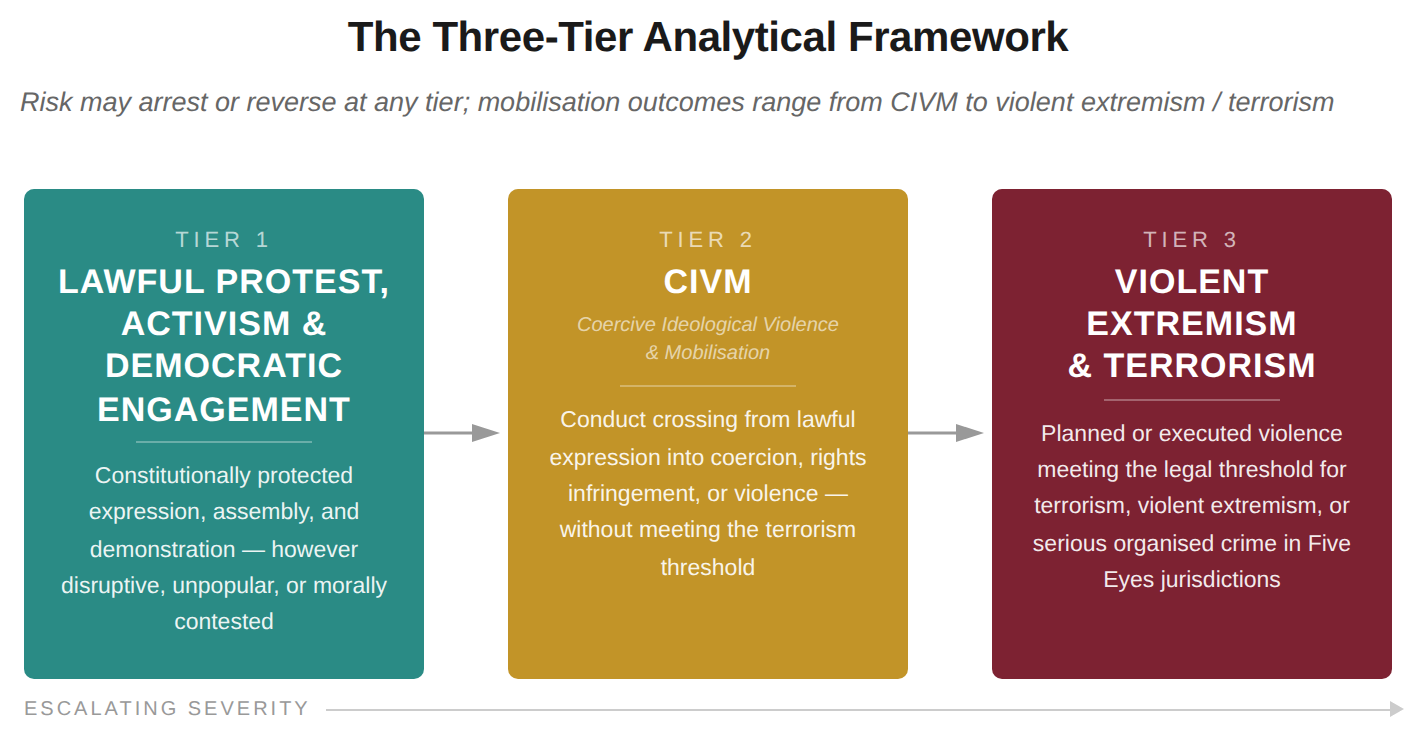
The programme separates protected democratic participation from coercive or violent mobilisation. CIVM is a project-defined analytical category for coercive, rights-infringing or violent ideological mobilisation that does not meet the project’s terrorism threshold. Terroristic attacks and thwarted terrorist plots remain separately coded.
Read the figure description
Tier 1 represents lawful protest, activism and democratic engagement. Tier 2 represents qualifying CIVM conduct. Tier 3 represents terroristic attacks or thwarted terrorist plots under the current project rules. The layout is explanatory rather than developmental: it does not treat lawful participation as an early stage of violence.
Current evidence base
Two governed public research datasets
The Social Context v1.5 release contains public country-year observations with indicator-level definitions, units, sources, coverage and comparison restrictions. The project lead-reviewed Case Database v4.2.3 releases 346 included records through a deliberately limited 22-field public schema.
- Master case records
- 347 authoritative workbook
- Public case rows
- 346 22 approved fields
- Populated downloadable series
- 78 76 explorer; 2 methodology-only
- Versioned context observations
- 4,141 4,017 explorer; 124 methodology-only
These counts describe the research database, not population incidence. Data completeness, legal definitions, public disclosure and source availability differ across countries and time. Every public release therefore requires a version, validation record and limitations statement.
Period context
A socio-technical timeline, not a causal timeline
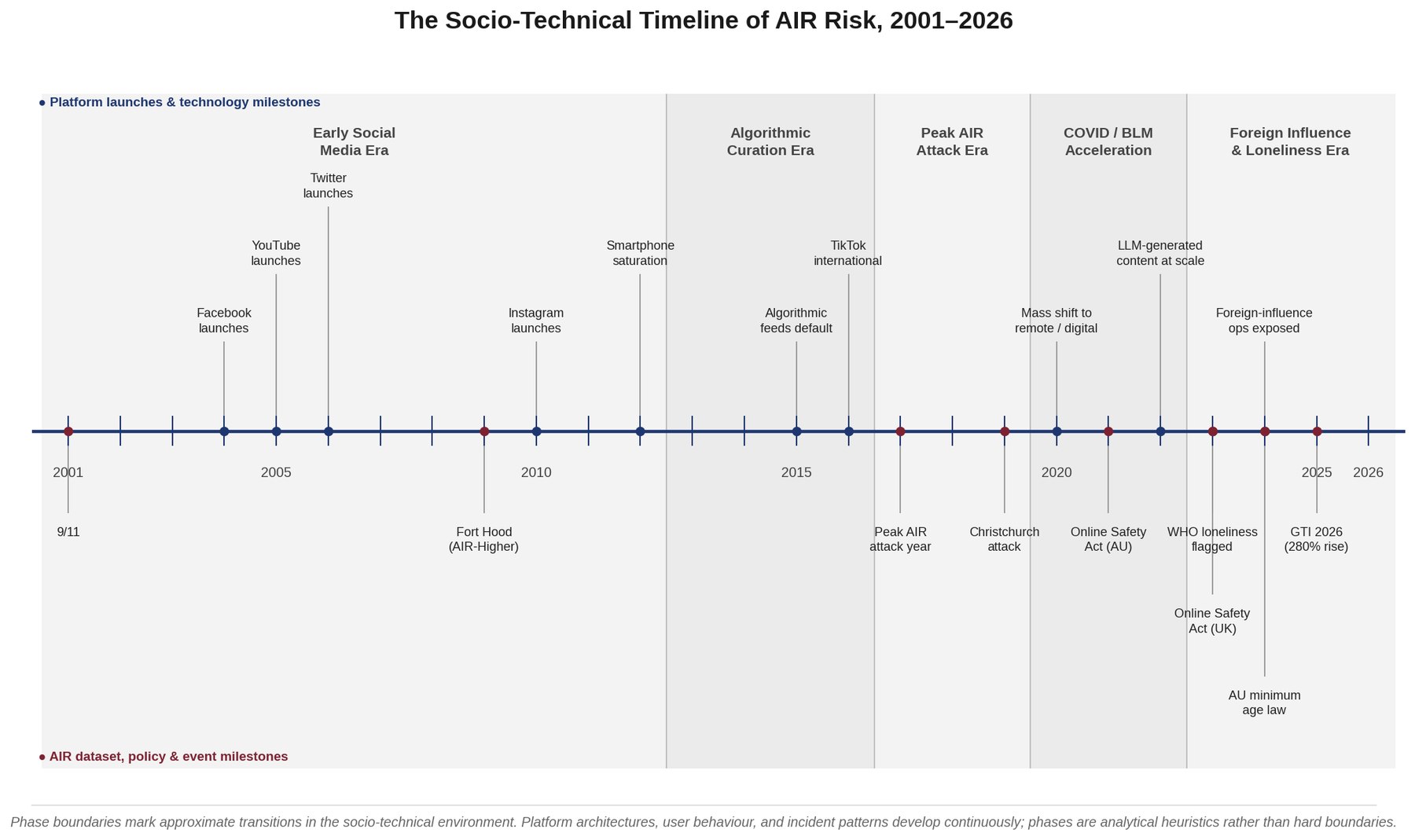
Selected technology, platform, policy and event milestones help users orient the recorded period. The phase labels are analytical heuristics. Their placement beside case patterns does not establish that one produced the other.
Read the figure description
The timeline places selected platform and technology milestones above a 2001–2026 axis and selected AIR dataset, event and policy milestones below it. It labels an early social-media era, algorithmic-curation era, peak AIR attack era, COVID and BLM acceleration, and a foreign-influence and loneliness era. The figure notes that these are analytical heuristics rather than hard or causal boundaries.
Evidence literacy
How to interpret material on this site
Information represented directly in a released dataset or cited public source.
A reproducible calculation from identified records, with its denominator and data version.
The programme’s reasoned reading of evidence, labelled and considered alongside credible alternatives.
A hypothesis or unresolved research problem that the current evidence does not establish.
This source-to-claim key complements the four labels used for fixed AIR Programme Insights. An Observed finding must be reproducible from observed records or statistical description; a Statistical association requires a disclosed analysis; an Informed hypothesis is an interpretation not causally established; and a Methodological or contextual observation identifies a pattern that may depend on coverage, classification, reporting or data generation. The two vocabularies describe different stages and are not interchangeable.
Religion, immigration pathway, age and other released personal descriptors are treated as descriptive case characteristics. They are not presented as causes or population-level risk factors. The public case records use a deliberately limited 22-field schema, and small sensitive aggregate cells require suppression.
Citing the programme
Preferred website citation
Sundberg, K.W. & Reynaud, A. (2026). Algorithmic Immersion Radicalisation (AIR): Five Eyes Research Dashboard. fiveeyesair.org.
Dataset downloads carry separate release metadata and should be cited with their specific version. Individual research outputs will carry their own preferred citation only after publication.